
Updated October 17, 2026. More Canadians are looking at electric cars right now. Sales are up. A new poll shows almost half of Canadians lean toward an EV for their next vehicle. The federal rebate is back. And big EV news keeps coming, from the Tesla Model 3 order pause to the new Tesla Roadster. This guide answers the main questions in plain words. It covers how many EVs are sold, what the rebate pays, what EVs cost and where you can charge.
How many EVs are Canadians buying?
Statistics Canada has the official numbers. In the second quarter of 2026, Canadians registered 58,811 new zero-emission vehicles. That is 26.7% more than a year earlier. Zero-emission vehicles made up 10.7% of all new vehicles registered, up from 8.6% a year before. In the same quarter, battery-electric registrations rose 37.4% and plug-in hybrid registrations rose 8.0%.
Global News reports that StatCan data shows EV purchases up 55% in August 2026 compared with August 2025.
There is a second set of numbers. J.D. Power says EVs made up 7% of the market in the third quarter, using dealer data. It says that rises to about 10% if you add plug-in hybrids and direct sellers such as Tesla. The two sources count different things, which is why the numbers do not match.
Where you live matters a lot. This table uses Transport Canada's figures for the first quarter of 2026.
| Province | EV share of new light vehicles, Q1 2026 (battery-electric and plug-in hybrid) |
|---|---|
| British Columbia | 20.8% |
| Quebec | 19.7% |
| Manitoba | 8.7% |
| Ontario | 8.4% |
| Alberta | 5.8% |
| Saskatchewan | 3.6% |
| Canada | 11.7% |
What does the federal rebate pay?
The rebate is called the Electric Vehicle Affordability Program, or EVAP. It covers new cars bought or leased from February 16, 2026 to March 31, 2031, or until the money runs out. Transport Canada says the amount drops each year.
| Year | Battery-electric | Plug-in hybrid |
|---|---|---|
| 2026 | $5,000 | $2,500 |
| 2027 | $4,000 | $2,000 |
| 2028 | $3,000 | $1,500 |
| 2029 | $3,000 | $1,500 |
| 2030 | $2,000 | $1,000 |
| 2031 | $2,000 | $1,000 |
The year that counts is the year the dealer sends in the form. It is not the model year of the car.
These are the main rules from Transport Canada.
- The car must be new and light-duty, which means under 8,500 pounds.
- The final price must be $50,000 or less, unless the car is made in Canada.
- The car must be made in Canada or in a country that has a free-trade deal with Canada.
- You can't apply yourself. The dealer applies the rebate after taxes and fees.
- A person can get one rebate in the five years of the program. A business can get up to 10.
- Leases of 12 months or more can qualify. A lease of 48 months or more gets the full amount. Shorter leases get less.
Transport Canada also keeps a list of 131 vehicle entries with an MSRP of $50,000 or less. A car can be missing from the list and still qualify if the final price is $50,000 or less. Being on the list does not promise a rebate either. Ask the dealer to confirm in writing.
Transport Canada's dashboard shows 44,314 rebate claims for 2026-27 as of June 2026. Quebec had 22,100 of them.
What do EVs cost?
J.D. Power's Robert Karwel told Global News that the gap between an average EV and an average gas vehicle is about $7,000. For hybrids, he said the gap is $3,000 to $4,000. He also said EVs are getting cheaper on average.
Prices on Vehonix are MSRP, which means before freight, fees and tax. Here are a few EVs on our site.
| Car | MSRP from | NRCan range (up to) | On the rebate list? |
|---|---|---|---|
| Toyota C-HR | $44,900 | 496 km | Yes, at $5,000 |
| Toyota bZ | $45,990 | 468 km | Yes, at $5,000 (XLE FWD) |
| Hyundai IONIQ 5 | $55,499 | 504 km | Not on the list |
| Tesla Model Y | MSRP not checked on Vehonix | 542 km | Yes, RWD-B at $5,000 |
The plug-in hybrid Mitsubishi Outlander has an electric range of 72 km on Vehonix. The 2026 Outlander PHEV ES is on the list at the plug-in amount of $2,500.
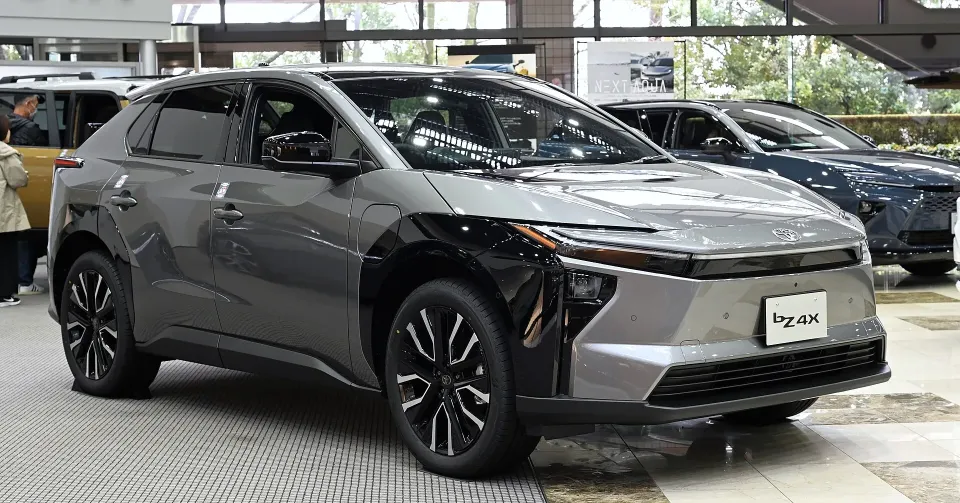
Photo: TTTNIS, CC0, via Wikimedia Commons
The Toyota bZ is one of the EVs on the rebate list.
Automotive News says the 2027 Kia EV3 is one of a few EVs priced under $40,000 before incentives. Clean Energy Canada's poll found that only one in five potential buyers is very aware of new EV models in the $30,000 to $40,000 range.
Where can you charge?
Transport Canada counted 39,220 public chargers in Canada at March 31, 2026. Of those, 30,741 are Level 2 chargers and 8,479 are Level 3 fast chargers. Level 2 is slower and works well when a car is parked for hours. Level 3 is the fast kind that you see on highways.
As of April 1, 2026, Canada had 1,077,457 light-duty EVs on the road. That works out to 27 EVs for every public charger. It is 36 in Quebec, 30 in British Columbia, 21 in Ontario and 20 in Alberta.
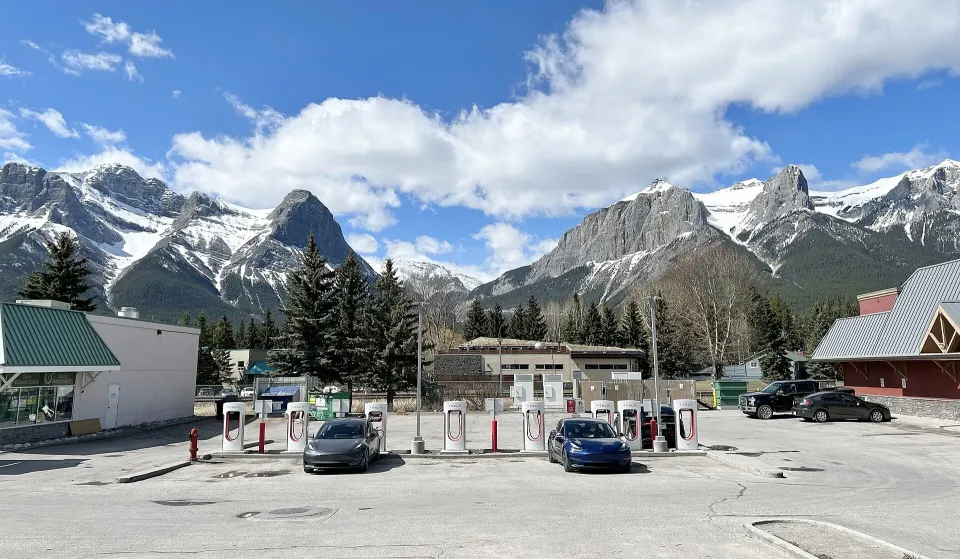
Photo: Sharon Hahn Darlin, CC BY 2.0, via Wikimedia Commons
Tesla Superchargers in Canmore, Alberta, in 2022.
In July, the federal government announced $9 million to install nearly 400 chargers, Global News reports. To find a charger near you, use the Natural Resources Canada locator map.
On payment, the Clean Energy Canada poll found that 69% of Canadians want public chargers to take credit or debit cards without an app. Today, many chargers need an app.
Cold weather cuts range. Read our Toyota bZ winter range and charging guide for a real example.
What Canadians say they want
An Abacus Data poll for Clean Energy Canada ran from September 18 to 23 and asked 2,762 adults.
- 48% lean toward an EV for their next vehicle. That is up from 45% in April.
- Interest is highest among people aged 18 to 29, at 67%.
- Among likely EV buyers, 42% say they might wait for more Chinese EVs.
- 37% of likely EV buyers say there are too few electric pickups.
- 62% of potential buyers knew about the $5,000 federal rebate.
One study reported by Motor Illustrated says Canadian Google searches for "electric vehicles" rose 57% in a year. That study looked at April 2025 to April 2026.
Chinese EVs and the Tesla Model 3 pause
Canada now allows a set number of Chinese-built EVs at a lower tariff. Global Affairs Canada's report, updated on October 9, shows 15,931 of the 49,000 spots used. Tesla paused Model 3 Premium orders in Canada and blamed the quota. We explain this in our Model 3 pause story. Geely also plans to launch in Canada in 2027. See our Geely Canada story.
Trucks and vans
Work vehicles are a different story. Transport Canada says battery-electric vehicles were 2.7% of new medium and heavy vehicle sales in the first quarter of 2026. Only 0.4% of medium and heavy vehicles on the road were battery-electric on April 1. Heavy trucks also face safety checks by police. See our story on OPP commercial vehicle charges in Ontario.
More electric news this week
Tesla showed a new Roadster on October 15 and Canadians can already reserve one. Read our Tesla Roadster guide. Porsche showed its Mission S concept on the same day. Porsche has not said if it will be electric. See our Porsche Mission S explainer.
Find an EV on Vehonix
- Browse every electric model on Vehonix with NRCan ratings.
- See the plug-in hybrid list if you want gas as a back-up.
- Compare the Toyota bZ and Toyota C-HR.
- Read our guide to comparing electric range and our C-HR vs bZ story.
- See all stories in EV and hybrid news.
What we don't know yet
- The third-quarter EV count from Statistics Canada. The latest quarter we found is the second.
- Which exact trims will qualify for the rebate as prices change.
- How fast Canada will add chargers. The numbers we found end on March 31, 2026.
- How the Chinese EV quota will be shared in the months ahead.
Vehonix has not tested these cars. This guide uses the sources below, and we will update it when new numbers come out.
FAQ
How much is the federal EV rebate in 2026? Up to $5,000 for a battery-electric or hydrogen car and up to $2,500 for a plug-in hybrid. It falls to $4,000 and $2,000 in 2027.
Do I apply for the rebate myself? No. The dealer applies it after taxes and fees. You sign forms at the dealership.
Is there a price limit? Yes. The final price must be $50,000 or less, unless the car is made in Canada.
How many EVs are sold in Canada? In the second quarter of 2026, 58,811 new zero-emission vehicles were registered, or 10.7% of new registrations, says Statistics Canada.
How many public chargers are there? Transport Canada counted 39,220 at March 31, 2026. About one in five is a fast charger.
Is the Tesla Model 3 eligible for the rebate? It was not on Transport Canada's list when we checked. A car off the list can still qualify. Ask the dealer.
Sources
- Transport Canada, Electric Vehicle Affordability Program overview and vehicle list
- Transport Canada, Canada's electric vehicle (EV) dashboard, data to March 31, 2026
- Statistics Canada, New motor vehicle registrations, second quarter 2026, September 8, 2026
- Global News, Canada's EV sales are growing, but not fast enough: expert, October 15, 2026
- Clean Energy Canada, Poll: EV interest climbs, October 9, 2026
- Automotive News, Canadian Q3 auto sales: EVs surge as pickup trucks lose ground, October 15, 2026
- Motor Illustrated, Tesla Model Y Tops Canadian EV Search Rankings
- Global Affairs Canada, Imports of electric vehicles from China, updated October 9, 2026
- Natural Resources Canada, Electric Charging and Alternative Fuelling Stations Locator
- Vehonix model pages (NRCan ratings and checked MSRP), viewed October 17, 2026
- Photos: Autzu-media (CC BY-SA 4.0) and Sharon Hahn Darlin (CC BY 2.0), via Wikimedia Commons


