
With the 2026 RAV4, Toyota dropped the gas-only model entirely. Every RAV4 sold in Canada is now a hybrid or a plug-in hybrid, and every one has all-wheel drive. That makes the RAV4 hybrid vs plug-in hybrid choice the most important one on the order sheet, and it boils down to a simple-sounding question: do you want to plug in?
The answer depends on how you drive, where you park and how much you are willing to spend up front. Here is how the two powertrains compare using official Natural Resources Canada (NRCan) ratings and Toyota Canada's specifications.
Two powertrains, one engine size
Both versions are built around a 2.5L four-cylinder engine, but they are tuned for different jobs.
- RAV4 hybrid: the fifth-generation Toyota Hybrid System produces 236 net system horsepower, up from 219 hp. It charges its own battery through braking and the engine, so there is nothing to plug in.
- RAV4 Plug-in Hybrid: a new-generation system with two electric motors and 324 horsepower, 22 more than before. Its larger battery can be charged from the grid, letting you drive a meaningful distance on electricity alone.
The plug-in powertrain was named Best Green Innovation at the Automobile Journalists Association of Canada's 2026 awards, according to Toyota Canada.
Hybrid fuel consumption ratings
NRCan's 2026 ratings for the RAV4 hybrid, all with AWD and running on regular fuel:
| Grade | City (L/100 km) | Highway (L/100 km) | Combined (L/100 km) |
|---|---|---|---|
| LE | 5.1 | 6.0 | 5.5 |
| XLE / XLE Premium | 5.2 | 6.1 | 5.7 |
| XSE / Limited | 5.4 | 6.3 | 5.8 |
| Woodland | 5.7 | 6.7 | 6.2 |
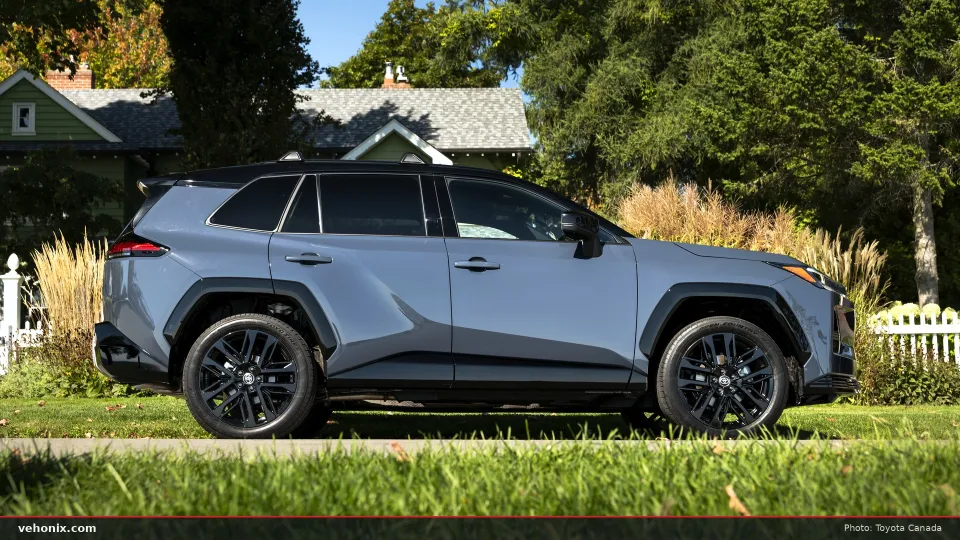
Two things stand out. First, like most hybrids, the RAV4 is more efficient in the city than on the highway, because stop-and-go driving lets the electric motors and regenerative braking do more of the work. Second, wheels and tires matter. The LE's 17-inch wheels give it the best rating, while the Woodland's all-terrain tires and rugged body add-ons cost it 0.7 L/100 km combined.
Plug-in hybrid ratings
For plug-ins, NRCan publishes two sets of numbers: a combined rating that blends electricity and gasoline, expressed in litres-equivalent per 100 km (Le/100 km), and a gasoline-only rating for when the battery's usable charge is depleted.
| Grade | Electric range | Combined (Le/100 km) | Gas mode city/hwy/comb (L/100 km) | Level 2 recharge time |
|---|---|---|---|---|
| SE | 89 km | 2.4 | 5.2 / 6.3 / 5.7 | 3 h |
| XSE | 85 km | 2.5 | 5.4 / 6.6 / 5.9 | 3 h |
| XSE Technology Package | 85 km | 2.5 | 5.4 / 6.5 / 5.9 | 2 h |
| GR SPORT | 79 km | 2.9 | 5.7 / 7.2 / 6.4 | 3 h |
NRCan's recharge times are for a 240-volt Level 2 connection. The XSE Technology Package is quicker because it is the only grade with an 11 kW onboard charger. The others use a 7 kW unit. It is also the only RAV4 with DC fast charging, through a CCS1 port, which Toyota says can take the battery from 10 to 80 per cent in about 30 minutes.
Even with a depleted battery, the plug-in SE's 5.7 L/100 km combined rating matches the hybrid XLE. In other words, you do not pay a big fuel penalty for the extra weight once the electric range runs out.
Who should choose the hybrid
The regular hybrid makes the most sense if:
- You cannot charge at home. Apartment and condo dwellers without access to an outlet will rarely get the full benefit of a plug-in.
- Your budget is capped around $40,000. The hybrid LE starts at $37,500 MSRP, while the cheapest plug-in, the SE, is $48,750.
- You do a lot of long highway trips. Over long distances, both versions spend most of their time burning gasoline, and the hybrid's 5.5 to 5.8 L/100 km combined ratings are close to the plug-in's gas-mode numbers.
For most RAV4 buyers, the hybrid remains the default choice. It is simple, efficient and available in seven grades, from the LE to the XSE Technology Package.
Who should choose the plug-in
The plug-in hybrid earns its higher price if:
- You can charge overnight. With up to 89 km of NRCan-rated electric range, a typical commute and errands can often be handled without starting the engine, at least in mild weather. Cold temperatures reduce electric range in any vehicle, so expect less in a Canadian January.
- You want more power. At 324 hp, the plug-in has 88 more horsepower than the hybrid.
- You plan to tow a small trailer. Toyota rates the plug-in SE and XSE to tow up to 3,500 lb. Toyota Canada does not publish a towing figure for the hybrid in its 2026 launch materials, so check with a dealer if that matters to you.
- You want the sportiest RAV4. The GR SPORT is offered only as a plug-in, though its larger wheels and sport tuning give it the lowest electric range of the four.
Charging basics for plug-in owners
Every RAV4 Plug-in Hybrid comes with a J1772 charging port and a dual-voltage cable that works on a standard household outlet (Level 1) or a 240-volt connection (Level 2). Level 1 is slow, so most owners who drive daily will want a Level 2 charger at home. With one installed, NRCan's figures suggest a full recharge in about three hours on most grades, and two hours on the XSE Technology Package.
The bottom line
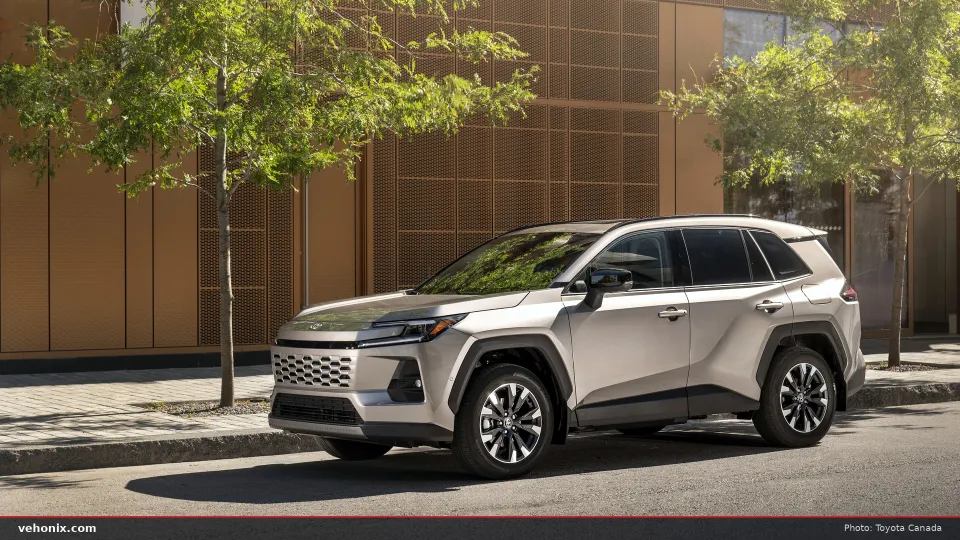
If you can plug in at home and most of your driving is local, the RAV4 Plug-in Hybrid can dramatically cut how often you visit a gas station, and it is quicker too. If you cannot charge regularly, or you want to keep the price under $45,000, the hybrid gives you excellent efficiency with nothing to think about. Either way, every 2026 RAV4 has standard AWD, TSS 4.0 and the new Toyota Multimedia system.

Compare specs and ratings for every grade on our Toyota RAV4 page.
Sources
- NRCan Fuel Consumption Ratings 2026 (Open Government Portal)
- NRCan Plug-in hybrid electric vehicle ratings 2012-2026
- Toyota Canada media: The Canadian-built RAV4 is all-new for 2026
- Toyota Canada media: Pricing for the all-new 2026 RAV4 Plug-in Hybrid
- Toyota Canada media: Toyota Canada highlights its growing electrified lineup (AJAC award)


