
Updated October 18, 2026. Gas is still pricey and winter is close, so a lot of drivers are looking at one number again: fuel consumption. Statistics Canada says gas cost 22.8% more in August than a year earlier. That makes the number on the label worth a second look.
This guide shows how the numbers work. If you want the dollars, read our page on what your car costs per 100 km. If you want the short version of the label, see how to read a Canadian fuel rating.
What L/100 km tells you
Canada rates fuel use in litres per 100 kilometres. That is the fuel a car burns to go 100 km. Lower is better. A car at 5 L/100 km uses half the fuel of a car at 10.
The nice thing about this scale is that it adds up in a straight line. Say you drive 20,000 km in a year. At 5 L/100 km you burn 1,000 litres. At 10 you burn 2,000. No tricks.
The three numbers on the label
Every new car gets a city number, a highway number and a combined number. Natural Resources Canada (NRCan) builds the combined one from 55% city and 45% highway driving. Use it to compare cars side by side.
Then look at the other two. They show how the car behaves where you drive.
- Gas cars do better on the highway. The Toyota Corolla (2.0 L) is rated 7.4 in the city and 5.7 on the highway.
- Hybrids do as well or better in town. The Corolla Hybrid is rated 4.4 in the city and 5.1 on the highway. The Camry Hybrid is 5.0 both ways.
Here is why that matters. In the city, the Corolla Hybrid beats the gas Corolla by 3.0 L/100 km. On the highway the gap is only 0.6. If most of your km are on the 401, the A-20 or the Trans-Canada, a hybrid saves less than the combined number suggests. If you mostly drive in town, it saves more.
How NRCan tests a car
The tests happen in a lab, on a machine called a chassis dynamometer. Think of a treadmill for cars. Since the 2015 model year, every car goes through five tests:
- A city test with 23 stops, started from a cold engine
- A highway test with no stops
- A cold test at -7°C
- An air conditioning test at 35°C
- A fast test, with a top speed of 129 km/h and hard acceleration
So the label already includes some cold, some heat and some speed. But our winters are often colder than -7°C, and real traffic is rarely as tidy as a lab cycle. The label is a fair way to compare two cars. It is not a promise about your tank.
Miles per gallon and your trip display
Many dashboards show U.S. miles per gallon. The two formulas, from NRCan, are:
- mpg (U.S.) = 235.21 ÷ L/100 km
- mpg (imperial) = 282.48 ÷ L/100 km
| L/100 km | mpg (imperial) | mpg (U.S.) |
|---|---|---|
| 5.0 | 56 | 47 |
| 7.0 | 40 | 34 |
| 10.0 | 28 | 24 |
That is also how to read the U.S. news. On September 28, Washington finalized a rule that aims for a fleet average of 34.9 mpg (U.S.) in 2031. That is about 6.7 L/100 km. The old plan was 50.4 mpg, or about 4.7 L/100 km. The rule covers new cars sold in the U.S. NRCan still rates every car sold in Canada in L/100 km.
Electric and plug-in cars
Electric cars use no fuel, so NRCan rates them in kilowatt hours per 100 km (kWh/100 km). To let you compare them with gas cars, it also gives a number in litres equivalent (Le/100 km). One litre of gas holds the same energy as 8.9 kWh of electricity. The Tesla Model 3 Premium is rated 15.3 kWh/100 km, or 1.7 Le/100 km.
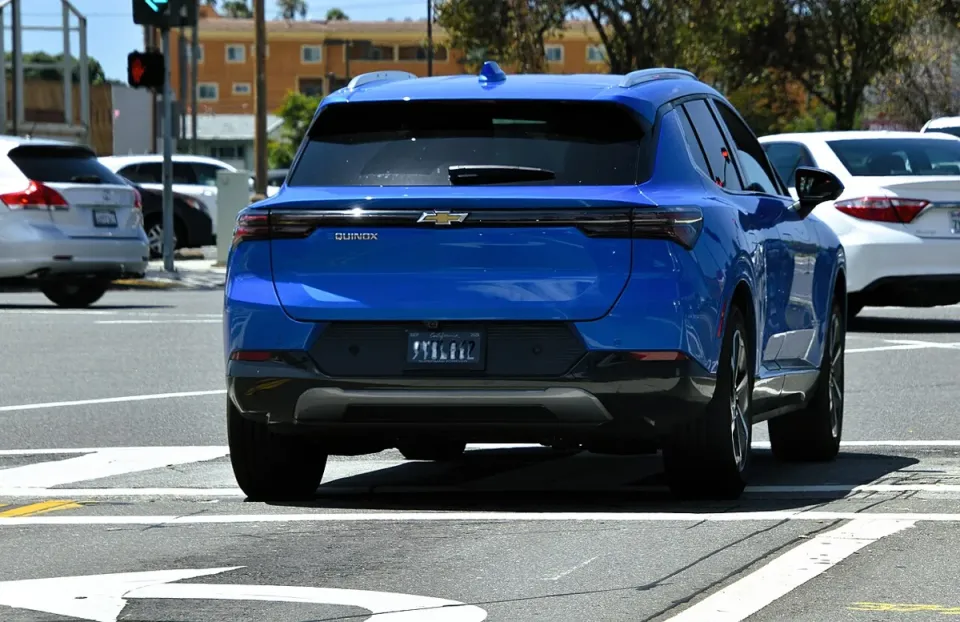
Photo: Charles from Port Chester, New York, CC0, via Wikimedia Commons
A plug-in hybrid has two ratings. One is the blend of electricity and gas. The other is gas only, for when the battery is empty. The RAV4 Plug-in Hybrid SE is rated 2.4 Le/100 km blended and 5.7 L/100 km on gas alone. Our guide to EV electricity use and cost goes deeper. For prices and rebates, see the EV guide.
Why your real number is higher
Four things move your number more than anything else:
- Cold weather. Read our winter guide.
- Speed. NRCan says a car uses about 20% more fuel at 120 km/h than at 100 km/h.
- Short trips. A cold engine burns extra fuel until it warms up.
- Tires and weight. Low tire pressure and a trunk full of stuff both cost you.
Our page on how to lower your fuel consumption covers each one.
How to measure your own number
The full-tank method is simple and it works on any car.
- Fill the tank until the pump clicks off. Reset the trip meter.
- Drive as you normally do.
- Fill up again the same way. Write down the litres.
- Divide the litres by the km, then multiply by 100.
Say you put in 42 litres after 600 km. That is 42 ÷ 600 × 100 = 7.0 L/100 km. Do it for three tanks and take the middle number. The trip display is good for feedback while you drive. The full-tank math gives you a number you can check yourself.
What one L/100 km is worth
NRCan's weekly average for regular gas was 188.4 cents a litre for the week ending October 13. In Quebec, the Régie de l'énergie reported 192.3 cents for the week of October 12. At 20,000 km a year, every 1 L/100 km is 200 litres. That is about $377 a year at the national price, and about $385 in Quebec.
| 2026 vehicle | Combined (L/100 km) | Litres a year at 20,000 km |
|---|---|---|
| Toyota Corolla Hybrid | 4.7 | 940 |
| Toyota RAV4 AWD LE | 5.5 | 1,100 |
| Honda Civic Sedan | 6.7 | 1,340 |
| Honda CR-V AWD | 8.4 | 1,680 |
| Ford F-150 2.7 L | 11.2 | 2,240 |
Want the lowest numbers on sale? See the lowest fuel consumption cars in Canada and our lists of the most fuel-efficient cars and hybrid cars. You can also see how front-drive and all-wheel drive compare in the Toyota Camry Hybrid.
FAQ
What is a good L/100 km number? Under 5.0 is excellent and only hybrids reach it. Gas-only cars on NRCan's 2026 list start at 6.7. Big SUVs and pickups are often above 10.
Is the combined number the one to use? Yes, to compare cars. Then check the city and highway numbers to see which one fits how you drive.
Why does my trip display not match the label? The label comes from lab tests. Your display shows how you actually drive, with real weather, real traffic and real loads.
How do I turn L/100 km into mpg? Divide 235.21 by the L/100 km for U.S. mpg. Divide 282.48 for imperial mpg.
Does the U.S. fuel rule change my car's rating in Canada? No. The rule sets fleet averages for new cars sold in the U.S. NRCan keeps rating cars in Canada.
Sources
- Natural Resources Canada, Fuel consumption testing
- Natural Resources Canada, Understanding the tables
- Natural Resources Canada, Fuel consumption ratings, model year 2026 (open data), updated October 6, 2026
- Natural Resources Canada, EnerGuide label for battery-electric vehicles
- Natural Resources Canada, Fuel-efficient driving techniques
- Natural Resources Canada, Weekly average retail prices for regular gasoline in 2026, week ending October 13, 2026
- Régie de l'énergie du Québec, Prix des produits pétroliers, week of October 12, 2026
- Statistics Canada, Consumer Price Index, August 2026, September 14, 2026
- NPR, The Trump administration weakens fuel efficiency standards for new cars, September 28, 2026
- Driving.ca, U.S. rolls back fuel-economy standards, reclassifies vehicle types, September 28, 2026
- Vehonix, Toyota Corolla, Honda Civic, Toyota Camry, Toyota RAV4 and Ford F-150 pages
- Photos: Gogerr (CC BY-SA 4.0) and Charles from Port Chester, New York (CC0), via Wikimedia Commons


