
What does the new Canada and Ontario auto plan mean for car buyers? On October 21, Ottawa and Ontario announced an $8.7 billion plan to fight U.S. tariffs. It puts $2.5 billion into auto plants. It also freezes Canada's emissions standard for new cars at the 2026 level through the 2029 model year.
Key takeaways
- The plan is worth $8.7 billion in total. Auto plants get $2.5 billion over two years.
- Ottawa pays up to $1.5 billion of the auto money. Ontario pays up to $1 billion.
- The fleet average emissions standard for new cars stays at 172 grams per mile through 2029.
- Yearly cuts start again with the 2030 model year. The goal is still 75% EV car sales by 2035.
- The plan does not change any EV rebate, any tax or any car price.
Why this plan is in the news today
Prime Minister Mark Carney and Ontario Premier Doug Ford made the announcement together on Wednesday. CBC News reports that the U.S. already charges a 25% tariff on finished vehicles from Canada that are not CUSMA compliant. CBC also reports that the U.S. has threatened to raise tariffs on cars, trucks and parts to 50% on January 1.
Most of the money goes to steel and to the Ring of Fire mining region. The car part is smaller, but it is the part that touches buyers.
What the $2.5 billion for auto plants does
The federal backgrounder says the money is for "large-scale automotive capital projects." In plain words, it helps carmakers pay for big plant upgrades in Canada. It adds to the $3 billion from the Strategic Response Fund that Ottawa put in place in February 2026.
The plan also sets up a Canada and Ontario Automotive Task Force. Its job is to watch over the auto steps in the plan.
The government did not name which companies or plants will get money. We will add that when it is public.
What the emissions freeze really means
Canada has a rule called the light duty vehicle greenhouse gas regulations. Each carmaker must keep the average emissions of all the new cars it sells under a limit. That limit was set to get tighter every year.
Now the limit stays at 172 grams per mile until the end of the 2029 model year. After that, the limit gets tighter each year again. The backgrounder says it will reach about 74 grams per mile by 2035.
CBC reports that Ottawa first planned to tighten the limit every year from 2026 to 2035. CBC also reports the U.S. rolled back its own fuel economy rules on Monday.
Will car prices go down?
Nobody can promise that, and the government did not say so. In my years around dealers, I have seen that sticker prices follow supply, demand, the dollar and tariffs much more than one rule.
Here is what is true. A tighter rule can push a brand to sell more EVs and hybrids, and sometimes to cut prices on them to hit the target. A frozen rule takes some of that push away for three model years. The backgrounder says it gives carmakers "near term flexibility" and lets them earn credits to use later.
So do not wait for a price drop because of this news. Shop the car you need, and compare the full price with fees.
What it means for EV supply in Canada
The plan does not stop anyone from selling EVs. It also does not change the 75% EV sales goal for 2035. Brands that sell more clean cars than the limit can still earn credits.
If you want an EV now, check the rebate first. The federal rebate drops on January 1, 2027. Our EV rebates by province guide has the numbers. Our cheapest EVs in Canada list shows what you can buy today.
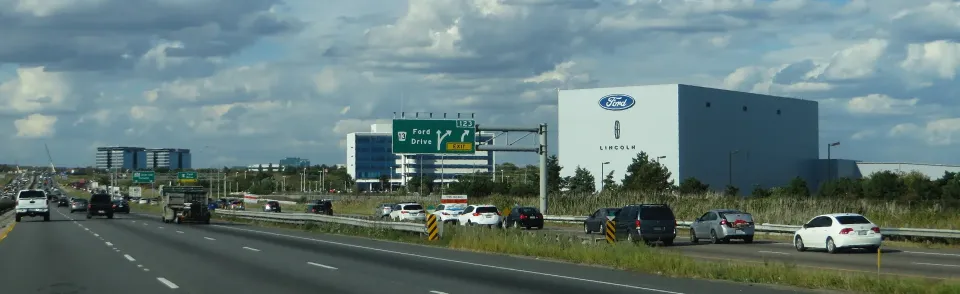
Photo: Ken Lund, CC BY-SA 2.0, via Wikimedia Commons. Ford's Oakville Assembly Plant in Ontario, 2016.
What it means for auto workers
Ontario builds most of the cars made in Canada. CBC reports Carney said the full plan will protect up to 290,000 jobs across the province. That number covers steel, mining and autos together.
Plants are still under stress. Stellantis workers just voted 97.3% for a strike mandate. Read our Stellantis strike mandate story for that side.
What to do if you are buying a car soon
- Get the full price in writing, with freight, PDI and fees.
- If you want an EV, try to take delivery before January 1, 2027, when the rebate drops.
- Check for open recalls before you buy any car, new or used. Our recalls page helps. This week, for example, Toyota is fixing the 2026 RAV4 plug-in hybrid.
FAQ
What did Carney and Ford announce on October 21, 2026?
They announced an $8.7 billion plan for steel, autos and critical minerals in Ontario. It includes $2.5 billion over two years for auto plant projects and a freeze on the emissions standard for new cars.
What is the Canada emissions standard freeze?
The fleet average limit in the light duty vehicle greenhouse gas regulations stays at 172 grams per mile through the 2029 model year. Yearly cuts start again in the 2030 model year.
Will new car prices in Canada go down because of this?
The government did not say prices will fall. Prices depend on many things, like tariffs, supply and the dollar. Do not plan your purchase around this rule.
Does this end EV rebates in Canada?
No. The plan does not change any rebate. The federal EV rebate is set to drop from $5,000 to $4,000 on January 1, 2027, under its own rules.
Is the 2035 EV target gone?
No. The backgrounder says the new target of 75% EV car sales by 2035 stays. That target comes from the auto strategy announced in February 2026.
Sources
- Innovation, Science and Economic Development Canada, "Backgrounder: Prime Minister Carney and Premier Ford launch new action plan to protect workers from tariffs and strengthen Ontario industries" (October 21, 2026): https://www.canada.ca/en/innovation-science-economic-development/news/2026/10/prime-minister-carney-and-premier-ford-launch-new-action-plan-to-protect-workers-from-tariffs-and-strengthen-ontario-industries.html
- CBC News, "Carney, Ford announce nearly $9B partnership to support steel, auto, critical mineral sectors" (October 21, 2026): https://www.cbc.ca/news/politics/carney-ford-auto-investments-tariffs-9.7389764
- Government of Ontario news release (October 21, 2026): https://news.ontario.ca/en/release/1008173


