
How much range does an EV lose in a Canadian winter? In CAA's real-world test at -7°C to -15°C, 13 EVs drove 14% to 39% less than their official range. Natural Resources Canada says to expect a loss of 25% to 30% in extreme cold. The gap between models is big, so the car you pick matters a lot.
Key takeaways
- CAA drove EVs from Ottawa to Mont Tremblant until the battery was empty. They all fell short of their official range, by 14% to 39%.
- The Chevrolet Silverado EV and Polestar 2 lost the least, at 14%. The Volvo XC40 Recharge lost the most, at 39%.
- An NRCan guide says EVs lose about 29% of range on average at -18°C. Gas cars lose about 19% at the same temperature.
- Fast charging is slower in the cold. In 15 minutes, the test cars added about 100 km on average.
- Warming the car while it is still plugged in can add 10% to 15% of range, says the same NRCan guide.
Why your EV label does not tell the full story
Every new EV in Canada gets a range number from Natural Resources Canada (NRCan). It is one year-round average. CAA points out that Canada does not post a separate winter number, so buyers do not get a clear picture of cold-weather range.
I have driven EVs through more than one Quebec winter. The first cold week always surprises new owners. The car is fine. It just has two jobs now. It has to move you, and it has to heat you. A gas engine makes heat for free as waste. An EV has to take that heat from the same battery that turns the wheels. A cold battery also gives up its energy less easily.
The CAA winter test, car by car
In February 2025, CAA drove a group of EVs from Ottawa to Mont Tremblant. The route mixed highway and winding back roads. The temperature was -7°C to -15°C. Each car ran until the battery was flat. CAA then compared the distance to the NRCan range.
| Vehicle | Distance in the cold | Official NRCan range | Difference |
|---|---|---|---|
| Chevrolet Silverado EV | 456 km | 724 km | -14%* |
| Tesla Model 3 | 410 km | 584 km | -30% |
| Polestar 2 | 384 km | 444 km | -14% |
| Kia EV9 | 349 km | 435 km | -20% |
| Volkswagen ID.4 | 338 km | 423 km | -20% |
| Chevrolet equinox-ev">Equinox EV | 337 km | 513 km | -34% |
| Ford mustang-mach-e">Mustang Mach-E | 334 km | 483 km | -31% |
| Honda Prologue | 334 km | 439 km | -24% |
| Ford F-150 Lightning | 296 km | 515 km | -35%* |
| Kia Niro EV | 285 km | 407 km | -30% |
| Hyundai IONIQ 5 | 262 km | 410 km | -36% |
| Toyota bZ4X | 255 km | 406 km | -37% |
| Volvo XC40 Recharge | 248 km | 409 km | -39% |
*CAA adjusted these two. The Silverado EV started at 73% charge and the F-150 Lightning at 89%.
Look at the order, not only the percent. The Tesla Model 3 lost 30%, but it still went the second farthest. A car with a big official range can lose more and still beat a car with a small one. For your daily needs, the kilometres matter more than the percent.
These are 2025 test cars. Some have been updated since. The bZ4X is now sold as the Toyota bZ, for example. Our Toyota bZ winter guide covers the newer model.
What NRCan says about cold and range
NRCan gives two useful numbers.
In an NRCan video, one of its EV experts says EVs can lose 25% to 30% of range in extreme cold. He adds that most Canadians drive 60 km or less a day. So even on the worst day, most drivers still have enough for the daily drive.
NRCan's AutoSmart guide says EV range drops by about 29% on average at -18°C. It says a gas car loses about 19% at the same temperature. So winter hurts every car. It just shows more on an EV, because the range number is on the screen in front of you.
The label itself already counts a little cold. NRCan runs one of its five lab tests at -7°C. That is a mild winter day in much of Canada. For more on how the label works, see our guide to comparing electric range.
Charging is slower in the cold too
The CAA test also timed a 15-minute fast charge on each car. On average, the cars added about 100 km, or 28% of the battery. The spread was huge.
| Vehicle | Range added in 15 minutes (shown on the car) |
|---|---|
| Tesla Model 3 | 205 km |
| Chevrolet Silverado EV | 199 km |
| Chevrolet Equinox EV | 131 km |
| Polestar 2 | 120 km |
| Volkswagen ID.4 | 112 km |
| Ford F-150 Lightning | 109 km |
| Kia EV9 | 105 km |
| Volvo XC40 Recharge | 90 km |
| Ford Mustang Mach-E | 71 km |
| Hyundai IONIQ 5 | 64 km |
| Kia EV6 | 58 km |
| Kia Niro EV | 35 km |
| Toyota bZ4X | 19 km |
CAA says the Tesla used a 150 kW charger because of the adapter. The others used 350 kW chargers.
For a clear contrast, CAA ran a second test in September 2026, in mild weather. CAA says those cars added about 15% more range in a 15-minute charge than the cars in the winter test. That fits what owners see. A cold battery takes power more slowly.
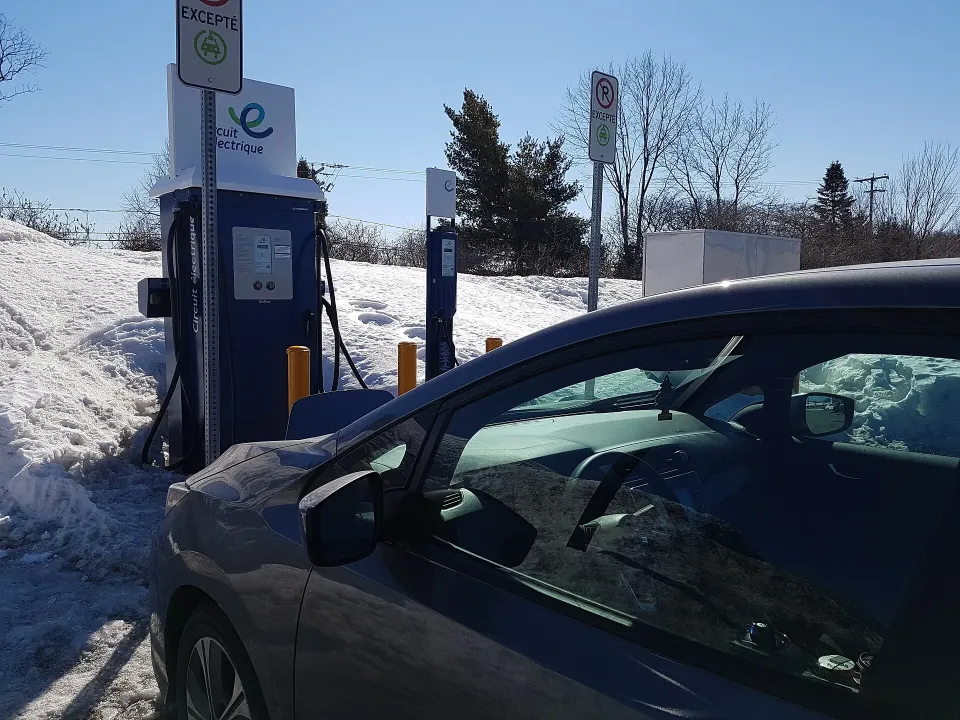
Photo: Bouchecl, CC BY-SA 4.0, via Wikimedia Commons. A Circuit électrique charger in Trois-Rivières, Quebec, in March.
How to work out your own winter range
Here is the simple math I use with friends who are shopping. Take the NRCan range and cut it by a third. That is close to the middle of the CAA results and close to the NRCan figure for -18°C.
| NRCan range | Range with a 30% loss | Range with a 40% loss |
|---|---|---|
| 300 km | 210 km | 180 km |
| 400 km | 280 km | 240 km |
| 500 km | 350 km | 300 km |
This is our math as a rough guide, not a test result. Your car, your speed and the cold will change it. CAA says range can drop as much as 40% below -15°C.
Then check it against your life. My own rule is simple. Aim for a winter range of at least twice your daily drive. If you drive 80 km a day, look for 160 km of winter range or more.
Tips that really help
These come from CAA and NRCan. I add my own notes where I have seen them work.
- Warm the car while it is plugged in. Many EVs let you set a departure time. The heat comes from the wall, not the battery. NRCan's guide says this can add 10% to 15% of range. This is the single best habit I know.
- Use the heated seats and wheel. CAA says they use less energy than the cabin heater. Warm hands and a warm back make a cooler cabin feel fine.
- Park inside if you can. A warmer battery gives more range and charges faster, CAA says. If you park outside, pick the sunny side of the street.
- Clear all the snow off. Snow adds weight and drag. In some provinces, it is also the law.
- Use winter tires. CAA says EVs are heavy, which can make slides on ice hard to control.
- On trips, charge often and short. CAA says EVs charge fastest when low. Going from about 10% to 80% saves time.
- Slow down on the highway. This is my own advice. Going from 120 km/h to 100 km/h makes a real difference in the cold.
A heat pump helps too. Many EVs now offer one. In my experience, it makes the biggest difference on short city trips in the cold. If you have the choice and you live where winters are long, I would take it.
What it costs you
Using more energy per kilometre means a higher power bill. Our math on the CAA results: a car that loses 30% of its range uses about 43% more electricity per kilometre. Our EV electricity cost guide shows how to price that where you live.
Does this mean you should not buy an EV?
No. I would not say that, and neither does CAA or NRCan. It means you should buy enough range for your winter, not your summer. A smaller, cheaper EV can be a great city car in January. It is a harder sell if you drive 200 km of highway each day.
If you are comparing prices, see our list of the cheapest EVs in Canada and the Chinese EVs coming. And check what you can still save in our article on EV rebates by province. For gas cars and winter fuel use, see winter fuel and EV consumption.
FAQ
How much range does an EV lose in winter in Canada?
In CAA's test at -7°C to -15°C, EVs lost 14% to 39% of their official range. NRCan says to expect 25% to 30% in extreme cold.
Which EV did best in the CAA winter test?
The Chevrolet Silverado EV went the farthest, at 456 km. It and the Polestar 2 lost the least, at 14% each.
Does preheating an EV save range?
Yes, if it is plugged in. NRCan's AutoSmart guide says warming the car on the charger can add 10% to 15% of range.
Do gas cars lose range in the cold too?
Yes. NRCan's guide says a gas car loses about 19% of range at -18°C. An EV loses about 29%.
Is EV charging slower in winter?
Yes. In CAA's winter test, a 15-minute fast charge added about 100 km on average. In CAA's September 2026 test, cars added about 15% more.
Sources
- CAA, "CAA conducts road test of EV range, charge in winter conditions": https://www.caa.ca/news/caa-conducts-road-test-of-ev-range-charge-in-winter-conditions/
- CAA EV Buyer's Guide, "EVs in Winter": https://evbuyersguide.caa.ca/content/evs-in-winter
- CAA EV Buyer's Guide, "Driving and charging": https://evbuyersguide.caa.ca/content/charging
- CAA-Québec, "2026 CAA EV Circuit: EVs go the distance, but charging, efficiency and costs vary": https://www.caaquebec.com/en/press-room/press-releases/2026-caa-ev-circuit-evs-go-the-distance-but-charging-efficiency-and-costs-vary
- Natural Resources Canada, "Electric vehicle question, Thierry (descriptive text)": https://natural-resources.canada.ca/corporate/electric-vehicle-question-thierry-descriptive-text
- Natural Resources Canada, "AutoSmart for students" (PDF), Unit 5, Winter driving: https://natural-resources.canada.ca/sites/nrcan/files/energy/pdf/AutoSmart_Students-ENG.pdf


