
Why is drunk driving in the news in Canada? Police across Canada laid a wave of impaired driving charges this week. Essex County OPP arrested five drivers in eight hours. Nova Scotia RCMP laid 23 impaired charges over Thanksgiving. Here is what the law says, what a first offence costs and how police test you at the roadside.
Key takeaways
- On October 20, Essex County OPP arrested five drivers for impaired driving in about eight hours.
- Nova Scotia RCMP checked 8,918 vehicles at 110 checkpoints over Thanksgiving. They laid 23 criminal charges for impaired driving.
- The Criminal Code limit is 80 mg of alcohol in 100 ml of blood. A first offence has a fine of at least $1,000.
- Police can ask any driver they lawfully stop for a breath sample. They do not need to suspect you have been drinking.
- In Ontario, a reading from 0.05 to 0.079 can mean a 7 day licence suspension and a $250 penalty.
What happened this week
The news came in fast. On October 20, Essex County OPP made five impaired driving arrests in about eight hours. The first was in Leamington just before 3 p.m. Another driver was stopped on Highway 401 near E.C. Row. One woman had a child in the car who was not buckled in properly, according to OPP.
In Nova Scotia, the RCMP shared its results from Operation Impact. This is a national road safety push run each year by the Canadian Association of Chiefs of Police. Over the Thanksgiving weekend, Nova Scotia RCMP checked 8,918 vehicles at 110 checkpoints. Officers laid 23 criminal charges for impaired driving. They gave out 14 roadside suspensions for alcohol or drugs.
"Every one of these enforcement actions represents an opportunity to prevent a serious collision before it happens," said Insp. Jeff Mitchell of Nova Scotia RCMP Traffic Services.
The same day, RCMP in Dartmouth arrested a 51 year old driver on Highway 107. Police say she gave two breath samples of 180 mg. That is more than twice the legal limit.
We covered the OPP Thanksgiving numbers and the fall truck blitz in our OPP Project Safe Haul story. This story is about the drinking and driving law itself.
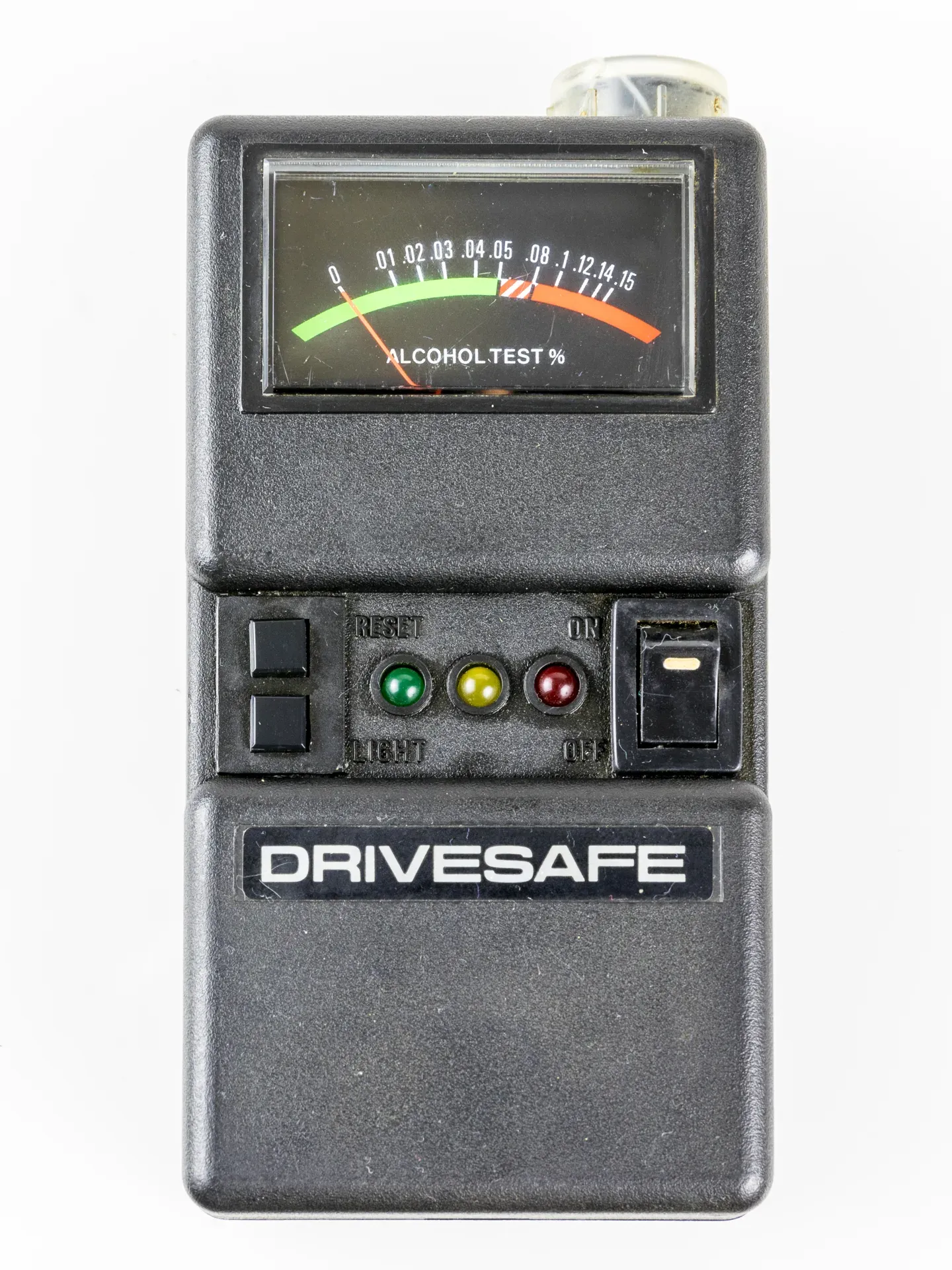
Photo: Raimond Spekking, CC BY-SA 4.0, via Wikimedia Commons. A personal breath tester, shown for context. Police in Canada use approved screening devices.
The legal limit in Canada
Under the Criminal Code, you cannot drive if your ability is impaired to any degree. That counts for alcohol, drugs or both.
There is also a fixed limit. It is a crime to have 80 mg or more of alcohol in 100 ml of blood within two hours of driving. People often call this "over 0.08."
Justice Canada lists these minimum fines for a first offence:
| Blood alcohol | Minimum fine |
|---|---|
| 80 to 119 mg | $1,000 |
| 120 to 159 mg | $1,500 |
| 160 mg or more | $2,000 |
| Refusing a breath test | $2,000 |
A second offence means at least 30 days in jail. A third means at least 120 days. If someone is killed, the top penalty is life in prison.
Police can test you without a reason
Since December 2018, police in Canada can use mandatory alcohol screening. If an officer lawfully stops you, they can ask for a breath sample on the spot. They do not need to think you have been drinking. A RIDE stop or a stop for speeding is enough.
Saying no is a crime on its own. As the table shows, it has the same $2,000 minimum fine as a high reading.
In my years of covering cars and roads, this is the rule that surprises drivers most. Many still think they can say no if they "only had one." You can't.
The warn range: 0.05 to 0.079
You can be under 0.08 and still lose your licence. Most provinces have their own rules for lower readings. These are not criminal charges, but they hit you right away.
In Ontario, a reading from 0.05 to 0.079 is called the warn range. Here is what it costs, according to the Ontario government:
- First time: 7 day licence suspension, an 8 hour course and a $250 penalty.
- Second time: 14 day suspension, a 16 hour program and a $350 penalty.
- Third time: 30 day suspension, a 16 hour program, a $450 penalty and an ignition interlock for six months.
You also pay a fee to get your licence back each time. Rules are different in each province, so check yours.
Zero alcohol for new and young drivers
In Ontario, some drivers must have no alcohol at all in their system. This covers:
- Drivers 21 and under.
- Anyone with a G1, G2, M1 or M2 licence.
- Drivers of trucks and buses that need a commercial licence.
The same zero rule covers cannabis. In a Toronto case made public this week, police also charged a 17 year old under the novice zero alcohol rule.
If you blow over 0.08 in Ontario
At the roadside, Ontario gives you these penalties before any court date:
- A 90 day licence suspension right away.
- Your vehicle is impounded for 7 days.
- An 8 hour course and a $550 penalty.
If you are later convicted in court, it gets worse. Since July 1, 2026, a first conviction in Ontario means a licence suspension of at least one year. You must also use an ignition interlock for at least one year. That is a small breath tester wired to your car. It will not start if it finds alcohol.
Cannabis and drugs count too
Drug impaired driving has the same penalties as drunk driving. Justice Canada sets these limits:
- 2 to 5 ng of THC per ml of blood is a less serious offence, with a fine of up to $1,000.
- 5 ng of THC or more is treated like being over 0.08.
- 50 mg of alcohol plus 2.5 ng of THC together is also a crime.
- Any amount of cocaine, meth, LSD, ketamine, PCP or magic mushrooms is a crime.
Police can use an oral fluid test if they suspect drugs. Signs like red eyes or odd speech can be enough to ask for one.
Plan your ride home
Halloween is next week, and holiday parties are not far off. Police often step up checks at this time of year. The Ontario government suggests these simple choices:
- Pick a driver who will not drink.
- Take transit, a taxi or a ride share.
- Call a friend or family member.
- Stay the night.
Also think about the morning after. Alcohol can still be in your blood when you wake up. If you are not sure, don't drive.
Winter is close too. Our guides on engine oil before winter and winter fuel use can help you get ready. You can also read about the OPP's recent truck charges in Ontario.
If you see a driver you think is impaired, call 911.
FAQ
What is the legal limit for drunk driving in Canada?
The Criminal Code limit is 80 mg of alcohol in 100 ml of blood within two hours of driving. You can also be charged below that if your driving is impaired. Many provinces add penalties from 0.05.
Can police in Canada make me take a breath test?
Yes. Since 2018, police can ask any driver they lawfully stop for a breath sample. They do not need a reason to think you drank. Refusing has a minimum fine of $2,000.
What happens if I blow 0.05 in Ontario?
A first time reading from 0.05 to 0.079 means a 7 day licence suspension, an 8 hour course and a $250 penalty. You also pay a fee to get your licence back.
What is the fine for a first drunk driving offence?
The minimum is $1,000 for 80 to 119 mg. It rises to $1,500 for 120 to 159 mg and $2,000 for 160 mg or more. The maximum is 10 years in jail.
Is driving high on cannabis the same as drunk driving?
Yes, the penalties are the same. Having 5 ng or more of THC per ml of blood within two hours of driving is a crime. A lower level of 2 to 5 ng has a fine of up to $1,000.
Sources
- Justice Canada: Impaired driving laws
- Government of Ontario: Impaired driving
- Nova Scotia RCMP: Operation Impact results, October 21, 2026
- Nova Scotia RCMP: Impaired driving arrest in Dartmouth, October 21, 2026
- CKNX / Blackburn News: OPP arrest five for impaired driving in eight hours
- CP24: Impaired teen driver nearly hit pedestrian, Toronto police
- Justice Canada: Mandatory Alcohol Screening became law on December 18, 2018


